
How to Search Bergen County Court Records
Bergen County court records are not kept in one single database. The state runs the court files. The county runs land and vital records. So the first job is to match the record to the right office. Superior Court civil, criminal, and family cases live in the New Jersey Courts systems. Traffic tickets and local complaints live in the municipal court system. Deeds, mortgages, and naturalization papers belong to the Bergen County Clerk. Wills and estates belong to the Surrogate.
For most court cases, start at the NJ Courts Find a Case page. It links separate tools for civil and foreclosure, criminal cases, criminal judgments, judgment liens, and Tax Court. Pick the tool that fits, then search by party name or by docket number. Have the full legal name or the docket number ready before you start, and confirm the venue reads Bergen so you do not pull a same-name case from another county.
- Decide the record type and the court that holds it.
- Open the matching tool on the NJ Courts Find a Case page.
- Enter a party name or docket number, then accept the access disclaimer.
- Filter or confirm the result shows Bergen as the venue.
- Click the docket number to open the case jacket, then request a certified copy if you need one.
Civil case jacket searches use a short, simple set of fields. The table below shows what the public civil search asks for.
| Field Label | Type | Required | Notes / Format |
|---|---|---|---|
| Search By | Tab / radio | Yes | Choose Party Name or Case/Docket Number. |
| Individual / Business | Radio | Yes for party search | Pick Individual for a person, Business for a company. |
| Last Name | Text | Yes | Use 3 or more letters; very short entries return only exact matches. |
| First Name | Text | Conditional | Same short-entry rule applies. |
| Search | Button | Yes | Runs the search and lists matching cases. |
The Bergen County Judicial System
New Jersey has one unified court system, and Bergen County is its own vicinage within it. The Superior Court is the main trial court. It is split into the Law Division for civil and criminal matters, the Chancery Division for general equity and family, and the Special Civil Part for smaller civil disputes and landlord-tenant cases. Above the trial courts sit the Appellate Division and the Supreme Court of New Jersey. The current Assignment Judge for the Bergen Vicinage is Carol V. Novey Catuogno, and the Trial Court Administrator is Kerri Lynn Walsh-Wood.
The state court page for the county is a good starting point for hours, leadership, and the main phone line. It also links interpreter and accessibility help.
You can read more on the official Bergen Vicinage page from NJ Courts.
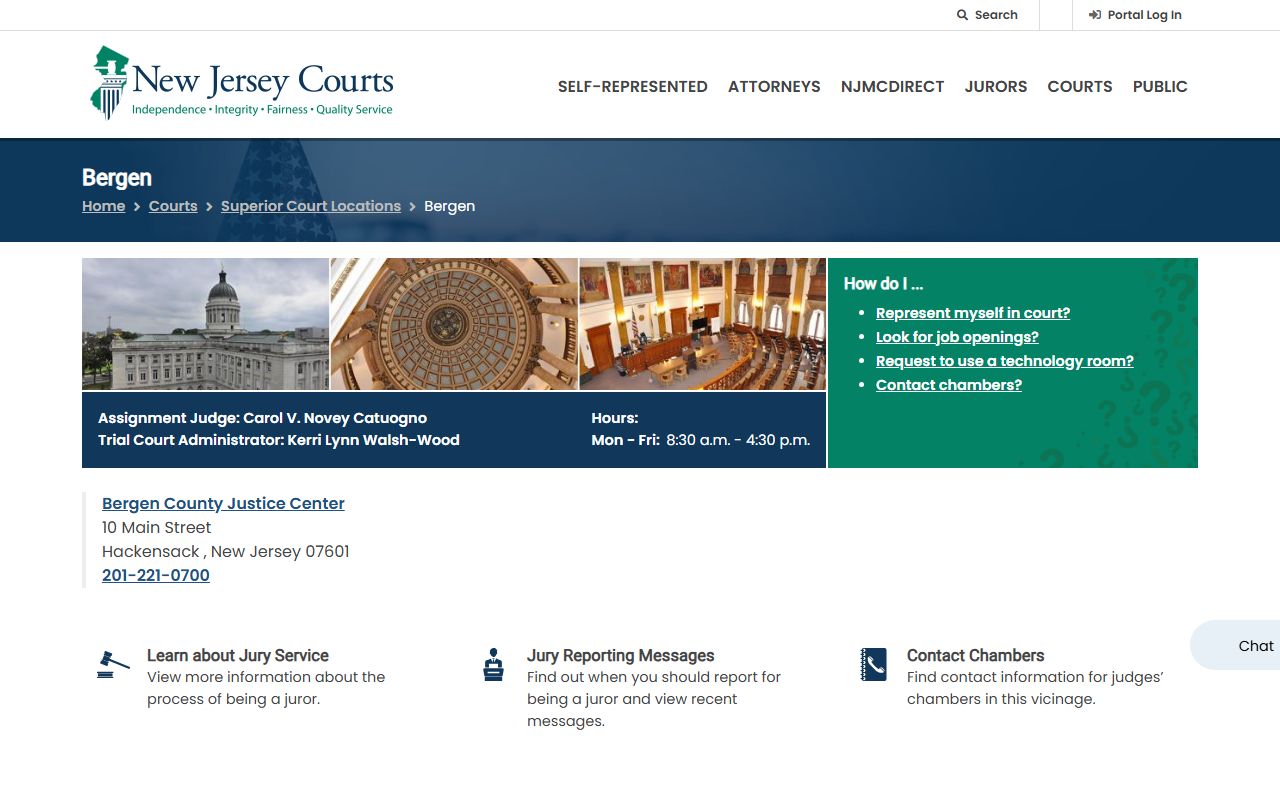
That page confirms the Justice Center as the seat of Superior Court trial work in the county. The case flow runs from the bottom up.
Case flow: Municipal Court › Superior Court (Law Division) › Appellate Division › Supreme Court of New Jersey
| Court | Jurisdiction | Case Types |
|---|---|---|
| Supreme Court of New Jersey | Highest state court | Discretionary appeals, constitutional questions |
| Appellate Division | Intermediate appeals | Appeals from trial divisions, Tax Court, agencies |
| Superior Court, Bergen Vicinage | Trial court of general jurisdiction | Civil, criminal, family, foreclosure |
| Tax Court of New Jersey | Statewide tax court | State and local tax appeals |
| Municipal Courts | Local courts | Traffic, parking, ordinance, disorderly persons |
| Surrogate's Court | County probate office | Wills, estates, guardianships of minors |
For a deeper look at the trial court, see the Bergen County Superior Court page.
Bergen County Courthouses
The county runs a compact justice campus in Hackensack. The Justice Center holds the Superior Court. The Surrogate sits next door on the fifth floor of Two Bergen County Plaza. The Central Municipal Court is a short walk away on Hudson Street. Most court business for the county happens within a few blocks.
The Sheriff keeps a detailed history of the building, which is worth a look before a first visit.
See the Bergen County Courthouse page for security, transit, and history notes.
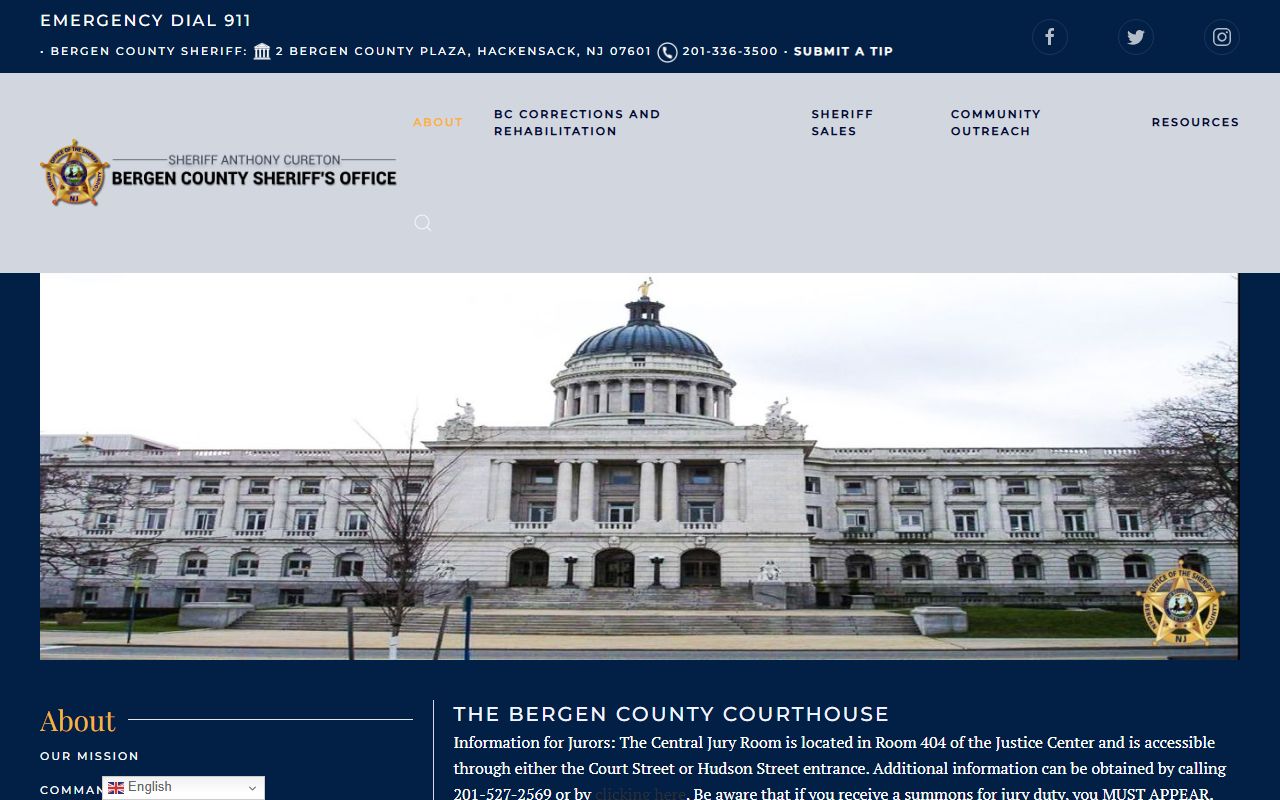
That page also notes the historic Rotunda, completed in 1912 and listed as a National Historic Landmark. The three cards below give the main public offices.
Bergen County Surrogate's Court
Two Bergen County Plaza, Suite 5000
Hackensack, NJ 07601
201-336-6700
Types of Court Records Available in Bergen County
Bergen County court records cover several case families. Each one comes from a different division or office. Civil records hold lawsuits, foreclosures, and landlord-tenant matters. Criminal records hold indictable cases from the Law Division. Family records hold divorce, custody, and support. Probate records sit with the Surrogate. Traffic and ordinance records sit with the municipal courts.
Land records are not court records at all. They are kept by the County Clerk and cover deeds, mortgages, and liens.
The County Clerk page is the gateway for those county records.
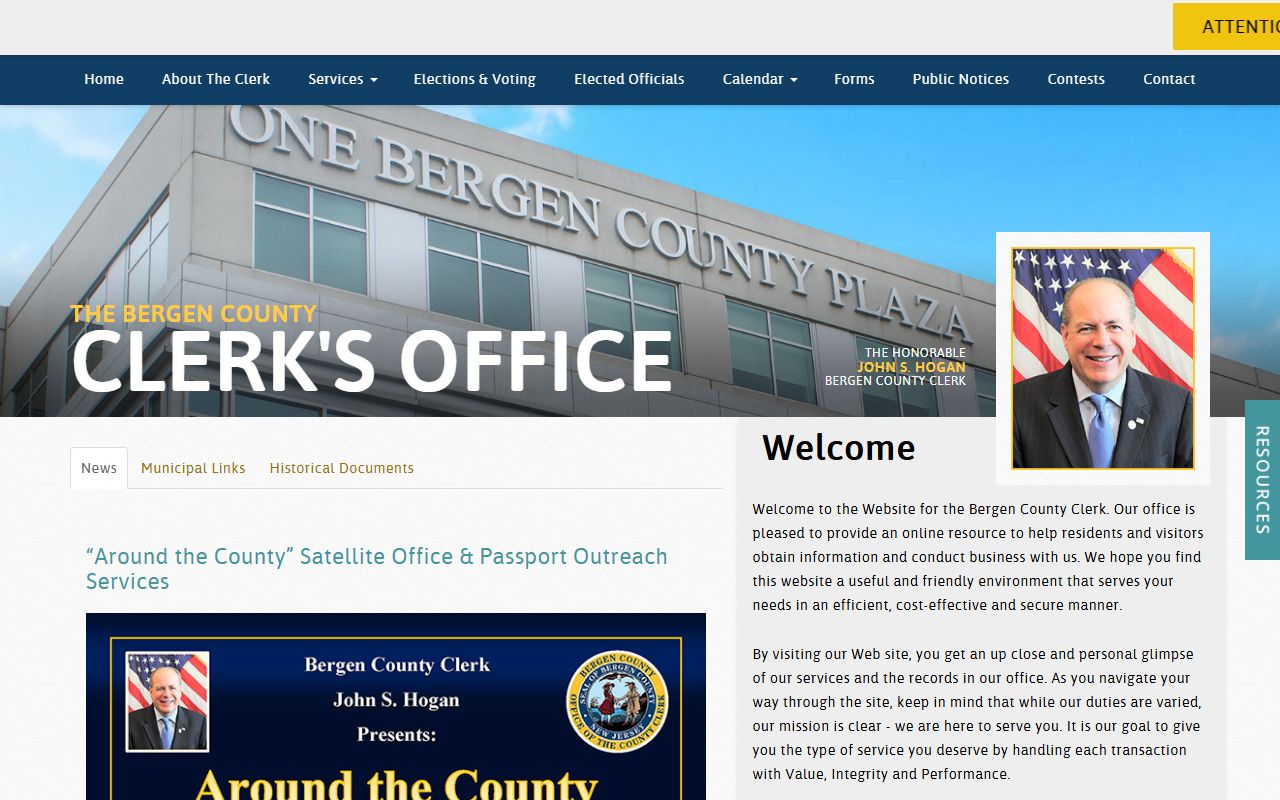
That office keeps records over 300 years old. Here is how the main record types break down:
- Criminal records - indictable cases, charges, pleas, and sentences from the Bergen criminal division.
- Civil records - lawsuits, foreclosures, and small claims handled by the Law and Special Civil Parts.
- Family and divorce records - divorce, custody, and support through the Family Division, with many files restricted.
- Probate records - wills, estates, and guardianships kept by the Surrogate's Court.
- Traffic records - tickets, parking, and local ordinance matters in the municipal courts.
What Bergen County Court Records Show
A court record is built from many small fields. The docket number tells you the case type and division. New Jersey uses letter prefixes, such as L for Law Division civil, FM or FD for family, and F for foreclosure. The caption names the parties. The entries track every step, from the first filing to the final judgment. Reading these fields in order tells the story of a case.
The table below lists the core fields you will see in a Bergen case search.
| Field | What It Shows |
|---|---|
| Case Number | The docket number, with a prefix for the case type and division. |
| Filing Date | The date the case began, also called the initiation date. |
| Parties | Names and roles, such as plaintiff, defendant, or the State. |
| Charges / Cause | The criminal charge or the civil cause of action. |
| Disposition | The outcome of a charge, a motion, or the whole case. |
| Sentence / Judgment | The final order, money judgment, or sentence. |
For the full walkthrough, see Bergen County court records and court dockets.
Public Access Laws for Bergen County Court Records
Two different rules control access in New Jersey. The Open Public Records Act, or OPRA, governs records held by county and state agencies. Court case records are governed by the Judiciary's own rule, Rule 1:38. The split matters. A County Clerk deed or a Sheriff report is an OPRA record. A Superior Court case file is a court record under Rule 1:38. Rule 1:38 starts from a presumption that court records are open, then lists clear exceptions for privacy and safety.
The county links its OPRA request path from its main site, which is also a good source for agency contacts.
The key statutes are short to summarize but deep in effect.
Key Statutes:
N.J.S.A. 47:1A-1 et seq. - the Open Public Records Act sets a right to see government records, with set exemptions and a seven-business-day response clock.
N.J.S.A. 2C:52-1 - defines expungement as the extraction, sealing, or isolation of arrest, court, and criminal-justice records.
N.J.S.A. 2A:4A-60 - safeguards juvenile delinquency records from public inspection, with narrow listed exceptions.
For a full breakdown of agency requests, see the Bergen County public records page.
Records That Are Restricted or Confidential
Not every court record is open to the public. Rule 1:38-3 lists the records kept out of public view. The list covers sealed and expunged matters, juvenile cases, domestic violence files, adoption reports, and medical or psychological records. Personal identifiers like Social Security numbers and account numbers are redacted under Rule 1:38-7. Grand jury material stays secret, and unfiled discovery is not public either.
The County Prosecutor handles indictable cases and the restricted material that comes with them.
To see a sealed record, a person usually must file a motion and show the court a legal reason. Sealing is never automatic. The court must enter an order under Rule 1:38-11. If you think a record was wrongly closed or wrongly open, the issuing court is the place to start.
Specialty Courts in Bergen County
Bergen handles several problem-solving programs through the statewide criminal structure. Recovery Court, once called Drug Court, blends judicial supervision, treatment, and drug testing for defendants with substance-use issues. Pretrial Intervention, or PTI, is a diversion track for many first-time, non-violent defendants; finishing it can avoid a conviction. The Veterans Assistance Project refers court-involved veterans to benefits, counseling, and housing help. NJ Courts listed 4,946 veteran referrals statewide since the project began, as of January 1, 2026.
The Bergen Vicinage also runs a Court User Resource Center for people without a lawyer.
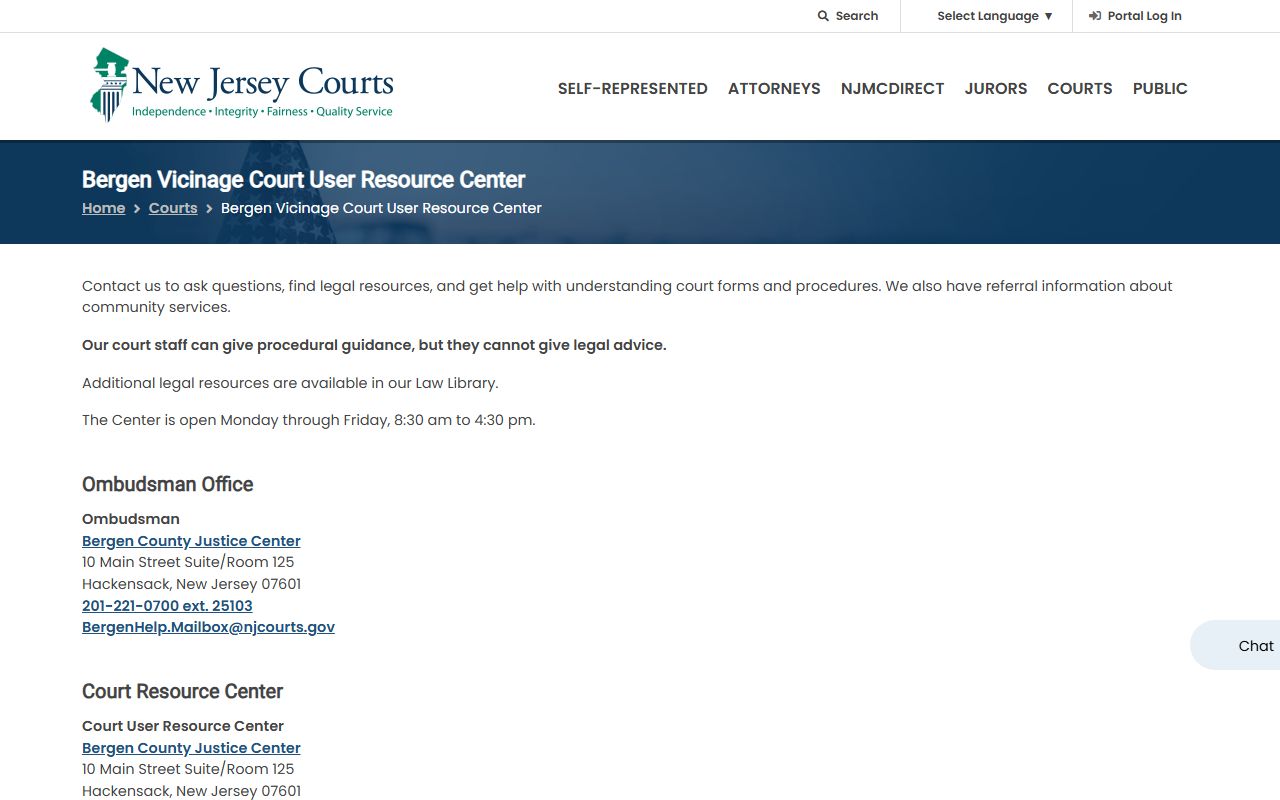
That center can explain forms and steps but cannot give legal advice.
Bergen County Sheriff and Jail
The Bergen County Sheriff's Office is led by Sheriff Anthony Cureton, with offices at 2 Bergen County Plaza in Hackensack. The Sheriff runs courthouse security, the Records Bureau, sheriff sales, and the county jail. The Bergen County Corrections and Rehabilitation Center sits at 160 South River Street. It holds 1,150 beds and more than 280 correction officers, and it has taken federal detainees under a U.S. Marshals contract since 2001.
Custody and warrant questions are handled through the jail and the courts, not through one public list.
For the full roster details, see Bergen County inmate records, and for active warrants see warrant records.
Marriage, Divorce, and Surrogate's Court
Marriage licenses in New Jersey come from the local registrar in the town where a couple lives, not from a county court. The Bergen County Clerk can perform a ceremony, but only after the couple already holds a valid license. Divorce is a Superior Court Family Part matter, filed through the Bergen Vicinage. Probate is different again; it belongs to the Surrogate, who proves wills and appoints executors.
The Surrogate's office keeps wills that date back to 1714, a deep record for family history work.
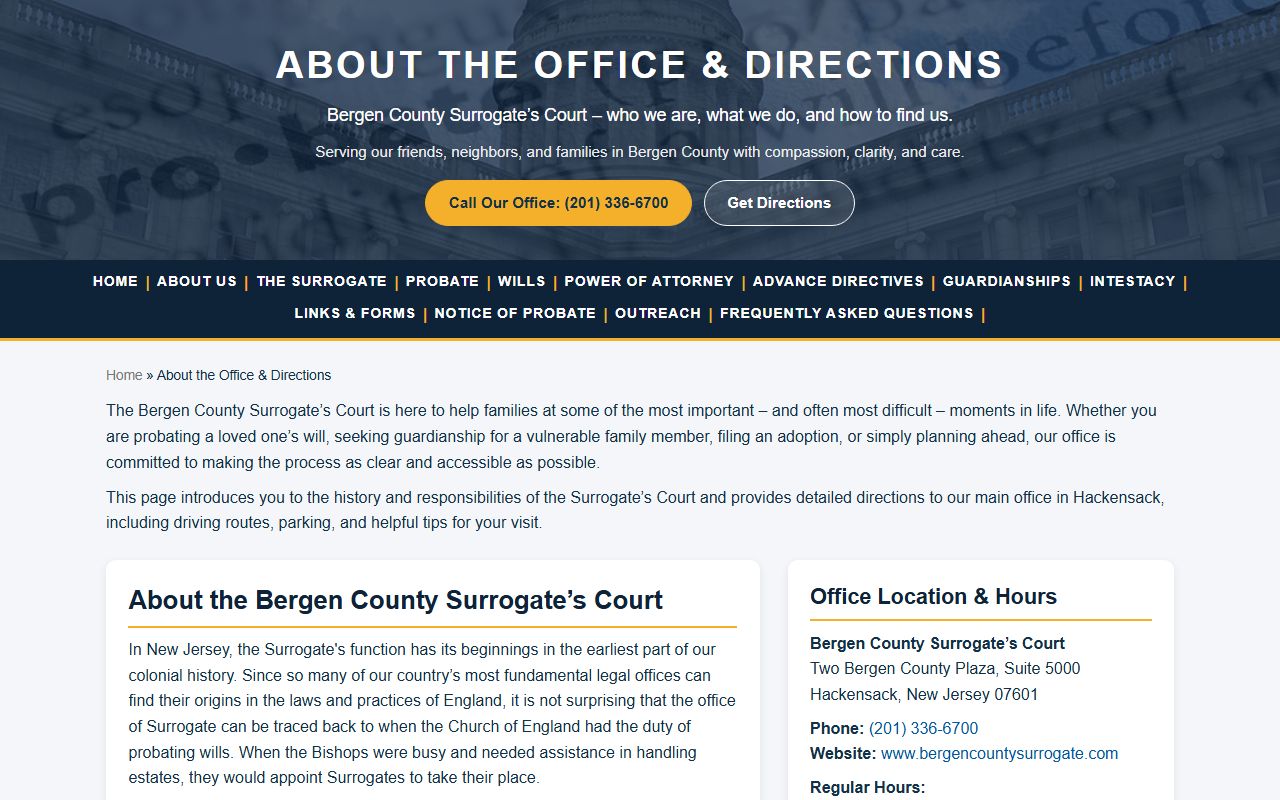
Start with marriage and divorce records or the Surrogate's Court page. A few probate terms come up often:
- Testator
- The person who made the will.
- Executor
- The person named in a will to carry out the estate.
- Conservator
- A person appointed to manage another adult's affairs.
Bergen County Court Records Fees
Fees depend on the office. The Bergen County Clerk publishes set charges for recorded documents and certified copies. The courts use the Judiciary fee schedule for case copies. Paid online case access through the Electronic Access Program runs $4 per minute and needs a subscriber account. The table below shows common County Clerk charges.
| Item | Amount |
|---|---|
| Public land-record copy (in records division) | $0.07 per page |
| Certified copy of a document (except military) | $10 first page, $2 each added page |
| Certification with gold seal | $10 |
| Records search, even if nothing is found | $10 |
Military and veteran certified copies are free. Confirm current fees before you order.
How to Interpret Bergen County Court Records
Court entries use short codes and legal terms. A charge is not a conviction. An indictment is just a formal charge from a grand jury, not a finding of guilt. Arraignment is the step where charges are read and a plea is entered. A disposition is the outcome. "Dismissed with prejudice" means the case cannot be refiled the same way; "without prejudice" leaves the door open. Docket prefixes also signal the division, so an L number is civil and an FM number is a divorce matter.
When a docket shows a long string of motions and conferences, that usually means the case took time to resolve. Read each entry in date order to follow the path.
Accuracy and Record Limitations
Online records can lag behind the courthouse. New tickets often take one to four days to appear. Paid tickets older than 90 days may drop off the public lookup. Case systems update on their own schedules, and a clerk may still be entering a recent order. A public search is a strong starting point, not a final word.
Note: Always confirm key dates, charges, and outcomes with the office that holds the record before you rely on an online result for any decision.
History of Bergen County Courts
Hackensack became the county seat in 1710, and the court history runs deep. The first courthouse was also a jail, three blocks down Hudson Street. The second burned during the Revolution. A third stood at the Ponds in Oakland by 1780, and the court returned to Hackensack in 1786. The fifth courthouse rose in 1819 on the current site, on land deeded by attorney Robert Campbell. Work on the sixth courthouse and jail began July 6, 1910, with architect James Rielly Gordon, and the Rotunda was finished in 1912. The Surrogate's line is older still, with the first East Jersey surrogate appointed in 1693 and wills proved in Bergen since 1714.
Frequently Asked Questions
How do I find a Bergen County Superior Court case?
Use the NJ Courts Find a Case page. Civil and foreclosure case jackets are searched by party name or docket number. Criminal cases and criminal judgments use separate tools. Pick Bergen as the venue where the option appears, and confirm the case caption and filing date before you trust a result. Statewide results can include people with the same name in other counties, so the venue check matters.
Is there a Bergen County "District Court"?
No, not as a New Jersey trial-court name. The main trial court in the state is the Superior Court, and Bergen County is the Bergen Vicinage. Municipal courts handle traffic, parking, and disorderly persons matters, while the Surrogate handles probate. People searching for a district court usually mean the Superior Court at the Justice Center.
Are Bergen County land records in the court search?
No. Deeds, mortgages, liens, and maps are kept by the Bergen County Clerk, not the courts. Use the Clerk's land records public search for those documents. The clerk's land search holds records from January 1, 1970 to the present, and older records may need staff-assisted access at the office.
More on the Bergen County Court Records FAQ page.