
The Bergen County Surrogate's Court
The Surrogate's Court sits at Two Bergen County Plaza, Suite 5000, on the fifth floor next to the courthouse. It is open Monday through Friday, 8:30 a.m. to 4:30 p.m. The Surrogate acts as both Judge and Clerk of the Surrogate's Court. The office probates wills, appoints executors, administrators, and guardians of minors, and manages funds held mostly for minors who receive judgments or inheritances.
The Surrogate also keeps deep historical records and explains its duties online.
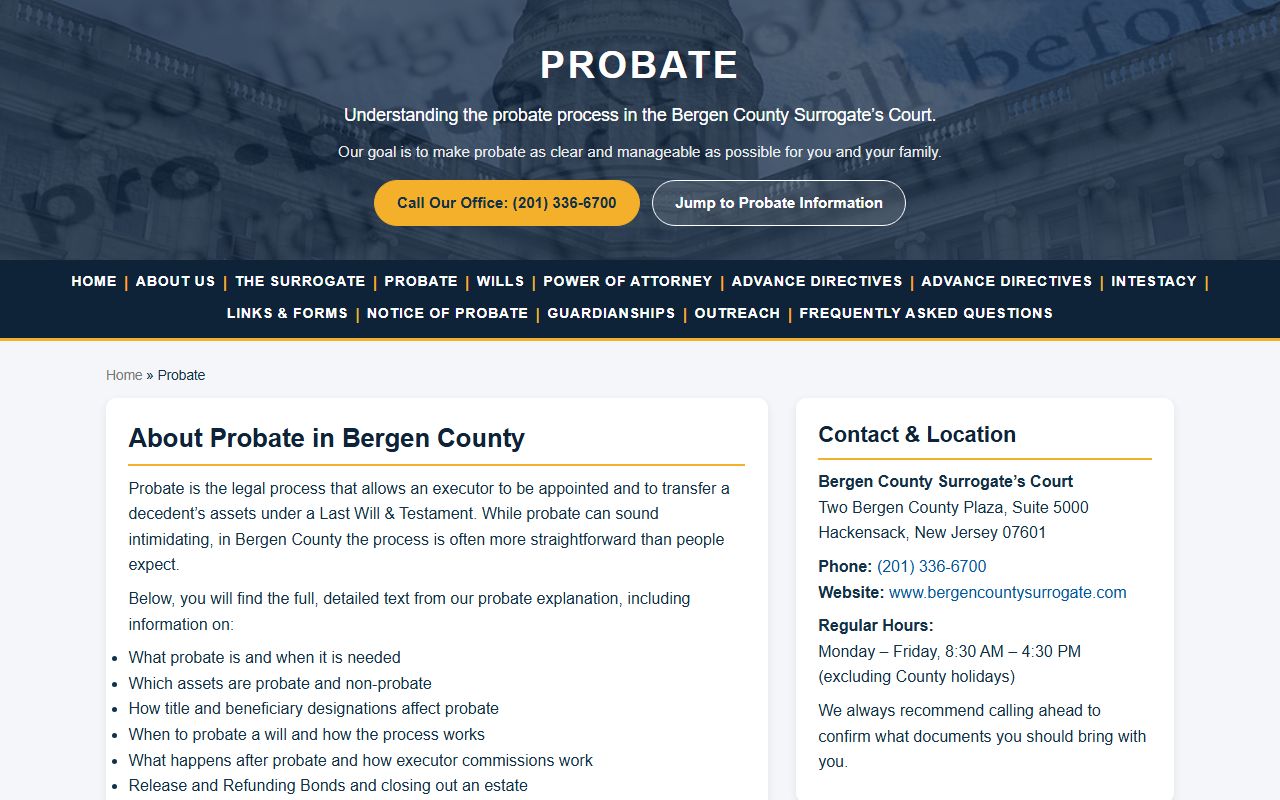
See the Bergen Surrogate probate page for the office's role.
Bergen County Surrogate's Court
Two Bergen County Plaza, Suite 5000
Hackensack, NJ 07601
201-336-6700
Mon-Fri 8:30 a.m.-4:30 p.m.
How to Search Bergen Probate Records
There is no full online probate search portal for Bergen, so most requests go through the Surrogate's office directly. You can ask in person, by phone, or by email, and the office can confirm what documents and fees a request needs. Having a few details ready makes the search faster.
| Method | What to Provide | Notes |
|---|---|---|
| In-person request | Decedent name, date of death, estate number if known | At the Surrogate's office in Hackensack. |
| Phone or email inquiry | Same identifying details | Call 201-336-6700 to confirm papers and fees. |
| Surrogate pamphlets and forms | Will or no will, executor or administrator details | Use official guidance and forms. |
For older estates, the office can help locate records that are not in any current online system.
Bergen County Probate Venue Rules
Venue decides whether the Bergen Surrogate handles an estate. Bergen jurisdiction exists if the person who died was domiciled in Bergen County at death. In some cases, it also applies when the person owned property located only in Bergen County. If neither fits, another county's Surrogate may be the right office.
Getting venue right at the start avoids a refiling later. When in doubt, call the Surrogate to confirm before you prepare papers.
What Probate Means in Bergen County
Probate is the process of proving a will and authorizing estate administration. The original will must be presented to the Surrogate to be proved under New Jersey procedures. Once the will is proved, the executor can transfer assets the way the will directs. Probate language can be confusing, so a few terms are worth defining up front.
- Testator
- The person who made the will.
- Executor
- The person named in a will to carry out the estate.
- Intestate
- Dying without a valid will.
- Letters of Administration
- Authority granted when there is no will.
- Guardianship
- Court authority to care for a minor or incapacitated person.
- Conservatorship
- Management of an adult's affairs with consent.
Probate Assets vs Non-Probate Assets
Not everything a person owns goes through probate. Probate assets are titled in the decedent's name alone. Non-probate assets pass outside probate based on title or a beneficiary designation. Knowing the difference tells a family how much of an estate the Surrogate process even touches.
| Type | Examples | Goes Through Probate? |
|---|---|---|
| Probate assets | Solely owned real estate, bank or brokerage accounts | Yes |
| Non-probate assets | Accounts with named beneficiaries, joint property | No, passes by title or designation |
Because non-probate assets pass on their own, some estates need little or no probate at all.
How to Probate a Will in Bergen County
The Surrogate lays out a clear order for probating a will. The steps below follow that process for a Bergen estate.
- Locate the original will and the death certificate.
- Confirm Bergen venue based on domicile or property.
- Contact the Surrogate to schedule and confirm the required papers.
- The named executor presents the will for probate; if there is no will, an interested party seeks administration.
- The Surrogate proves the will and issues letters testamentary or administration.
- The executor marshals assets, notifies heirs, pays debts and taxes, and distributes the estate.
Letters Testamentary and Administration
Letters are the authority that lets someone act for an estate. Letters testamentary go to the executor named in a will. Letters of administration go to an administrator when there is no valid will to control. Banks and other institutions usually require these letters before they will release estate assets. The Surrogate issues them once the requirements are met.
Guardianships and Minor Funds
The Surrogate appoints guardians of minors and manages money held for them. The office administers and invests more than $30 million in funds, mostly for minors who receive judgments or inheritances. When a minor is owed money from a case or estate, the Surrogate often holds and protects those funds until the minor comes of age.
Guardianship of an incapacitated adult is handled as a Superior Court matter, with the Surrogate acting as Deputy Clerk for the Probate Part.
Contested Probate Part Matters
Uncontested probate can feel administrative, but contested matters move into a court docket. As Deputy Clerk of the Superior Court, Chancery Division, Probate Part, the Surrogate dockets will contests, estate disputes, accountings, mental incompetency matters, guardianships of incapacitated adults, and adoptions. That dual role is why a simple estate stays at the Surrogate while a fight over a will becomes a Superior Court case.
Adoption records handled this way are restricted from public access. For the broader court framework, see Bergen County court records.
Bergen County Probate Fees
The Surrogate's page gives a general probate cost, with exact fees depending on the documents and services. The table below shows the documented range; confirm current fees with the office before filing.
| Item | Amount |
|---|---|
| General probate cost | About $100 to $200 |
| Additional services and documents | Vary; confirm with the Surrogate |
| Phone for fee questions | 201-336-6700 |
The Surrogate's FAQ answers many common probate and estate questions.
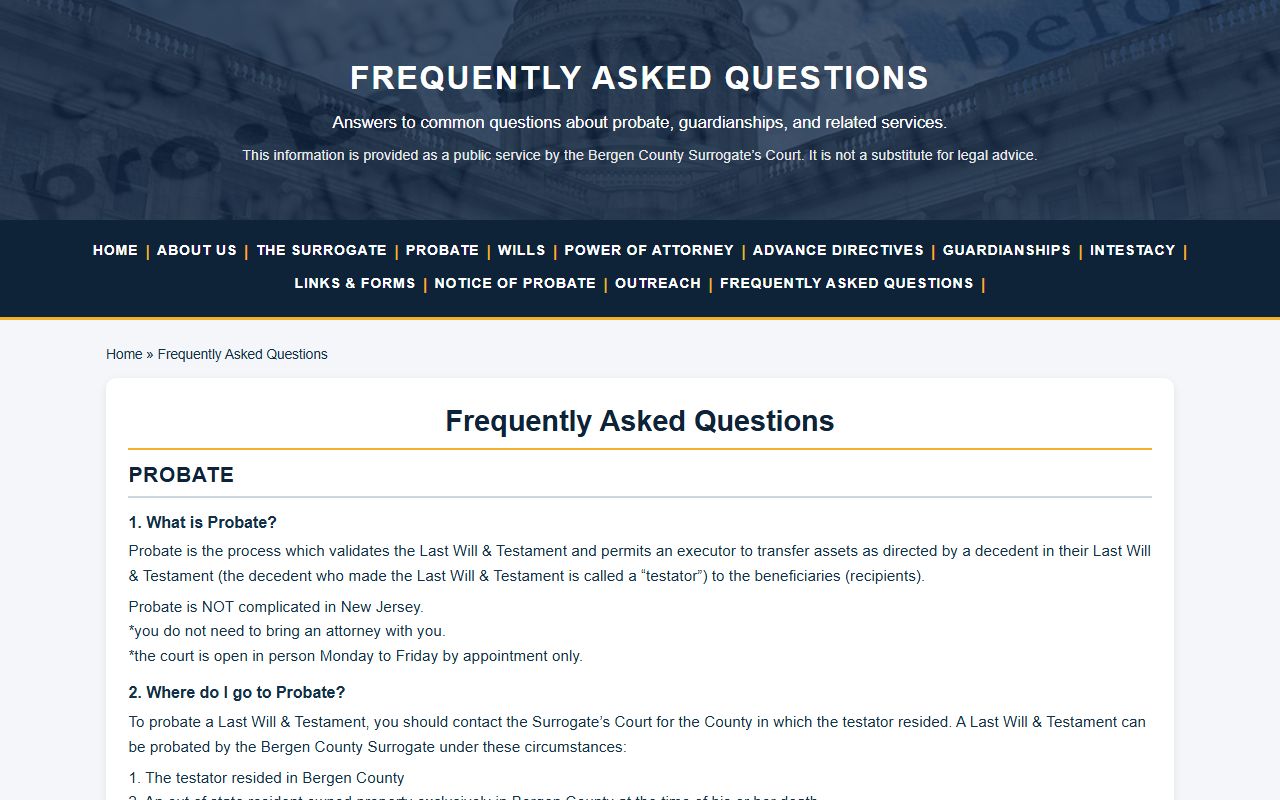
Check the Surrogate FAQ page before you call.
Old Wills Back to 1714
Bergen's probate history is unusually deep. The Surrogate's Court says it stores and maintains wills dating back to 1714. New Jersey's first East Jersey surrogate was appointed in 1693, and the office became an elected county constitutional position under the 1844 state constitution, with a five-year term. That history makes the Surrogate a strong resource for genealogy and old estate research.
The office also marked the loss of a longtime Surrogate.
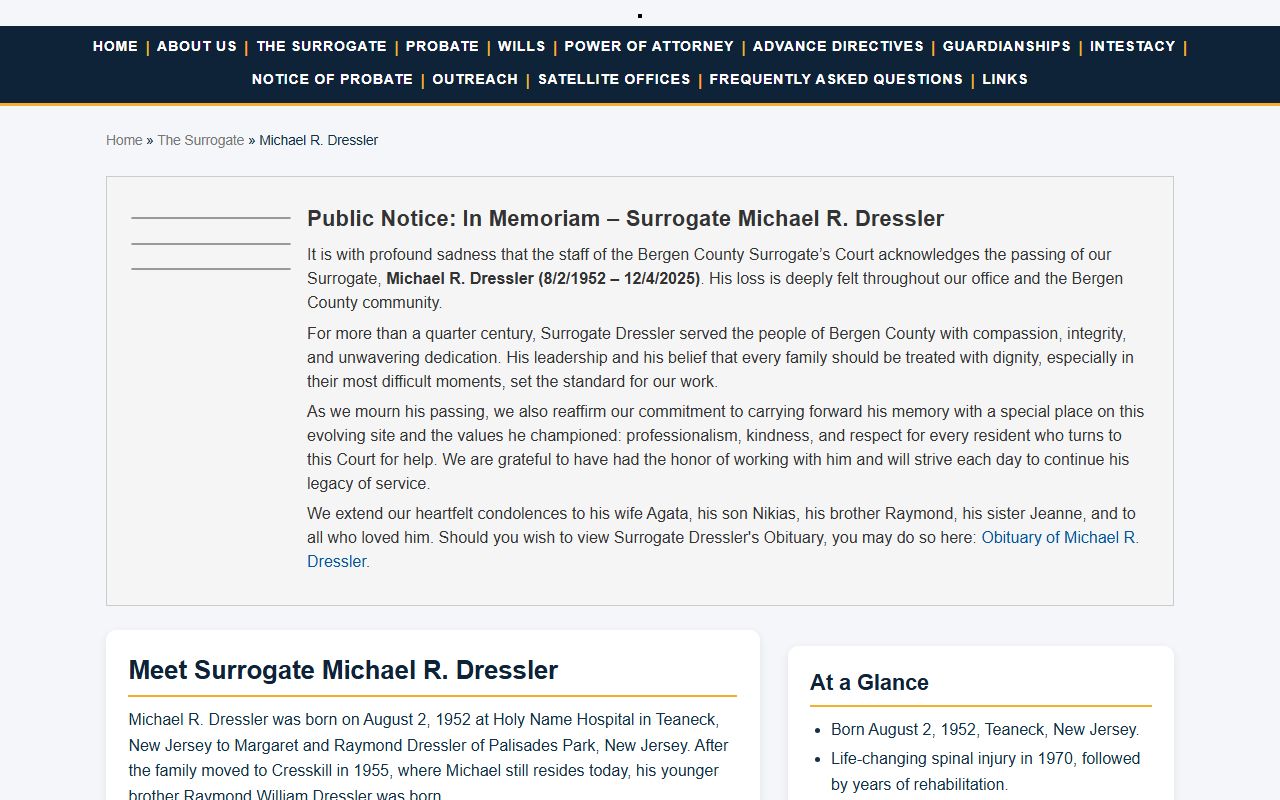
The memorial page notes longtime Surrogate Michael R. Dressler, who served more than a quarter century and died December 4, 2025. Confirm the current Surrogate with the office before relying on a name.